
Action plan example: what a plan people actually follow looks like
A complete action plan example with goal, timeline, steps, owners and a weekly checkpoint, plus the anatomy that makes a plan executable.
- An action plan answers one question: who does what by when, to reach which goal.
- It has five parts: a measurable goal, a timeline with phases, concrete steps, one owner per step and a checkpoint.
- Each step should be finishable by one person within about a week; most goals need 5 to 15 steps.
- A 15-minute weekly checkpoint keeps the plan current after kickoff.
- In SketchMind, plans live in the Plans tool (/plans), which drafts steps from a board; steps can move to Agenda or a Focus session.
Search for an action plan example and you mostly find a table with empty columns. The template is not the hard part. The hard part is knowing what a good plan looks like once it is filled in: concrete enough that someone could carry it out without asking you anything. Here is the anatomy of an action plan that gets followed, a complete worked example, and a faster way to draft yours.
Short answer: An action plan states one measurable goal, a timeline with phases, 5 to 15 concrete steps with exactly one owner and one deadline each, and a regular checkpoint. For example: launch a monthly newsletter to 500 subscribers by October 30, in three two-week phases, with seven steps owned by three people and a 15-minute review every Friday.
What is an action plan?
An action plan is a list of steps pointed at one goal, in order, with a name and a date on each step. It answers one question: who does what by when, to reach which goal? It is not a strategy document and not a to-do list. A to-do list is a pile of tasks; an action plan points those tasks at a goal.
The test: could a colleague pick it up, see the goal, and know what the next step is and whose it is? If a step says "improve onboarding" with no owner and no date, you have intentions, not a plan.
What should an action plan include?
An action plan should include a measurable goal, a timeline, concrete steps, one owner per step and a checkpoint. Each part has a typical way of failing:
The parts of an action plan
|Part|What it answers|Common failure|
|---|---|---|
|Goal|What does done look like, measurably?|Vague ("grow the newsletter")|
|Timeline|By when, overall and per step?|Only a final deadline, no waypoints|
|Steps|What are the concrete actions?|Steps that are really projects|
|Owners|Whose name is on each step?|"The team" owns it, so nobody does|
|Checkpoint|When do we look at this again?|Never, so the plan dies after kickoff|
Two rules of thumb. A step should be small enough that one person can finish it within a week; anything bigger gets split. And every step gets exactly one owner, because shared ownership works out as no ownership.
A complete action plan example
This example plans a company newsletter launch over six weeks.
Goal: launch a monthly company newsletter, with the first edition sent to at least 500 subscribers by October 30.
Timeline: six weeks in three phases: setup (weeks 1 and 2), content (weeks 3 and 4), launch (weeks 5 and 6).
Steps, owners and deadlines
|Step|Owner|Deadline|
|---|---|---|
|Choose the email platform and set up the account|Dana|Sep 25|
|Design the newsletter template|Marco|Oct 2|
|Add a signup form to the website|Dana|Oct 2|
|Draft edition #1 (three stories, one interview)|Priya|Oct 16|
|Collect 500 subscribers via site, social and event list|Marco|Oct 23|
|Review, test-send and fix rendering|Priya|Oct 27|
|Send edition #1|Dana|Oct 30|
Checkpoint: 15 minutes every Friday. Is any step slipping, and does the goal still make sense?
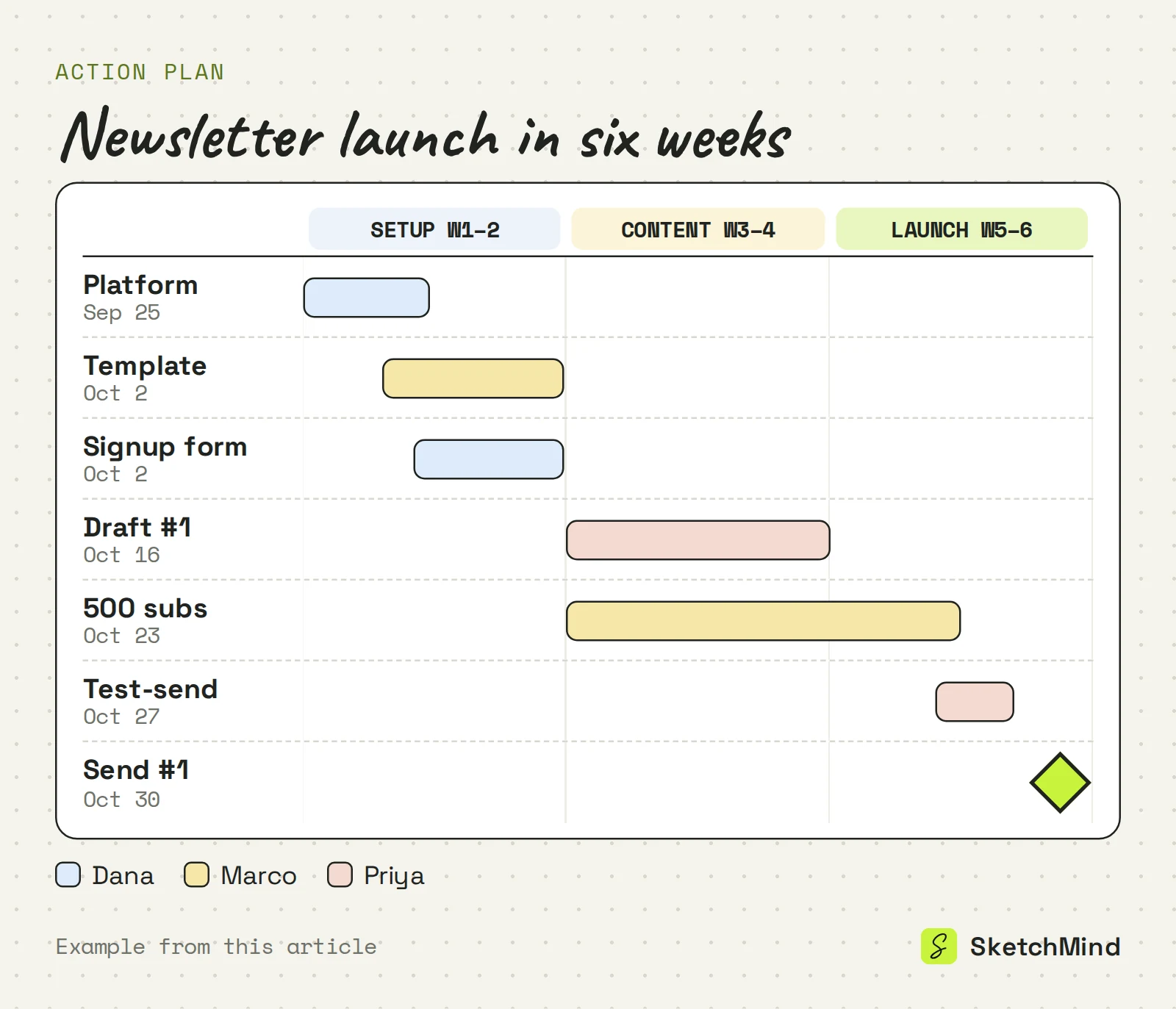
What makes this executable: every step is one action with one name and one date, the phases give you waypoints instead of a single deadline, and the checkpoint is written into the plan instead of left to good intentions.
How do you keep an action plan on track?
Keep an action plan on track with a short, fixed review. Most plans fail about two weeks in, when reality has moved and the document has not. A weekly 15-minute checkpoint asks three things: which step is late, who needs help, and does the goal still hold?
- Look at the steps due this week and last week.
- For each late step, change the date, the owner or the scope on the spot.
- Check the goal. If it no longer makes sense, change it and say so.
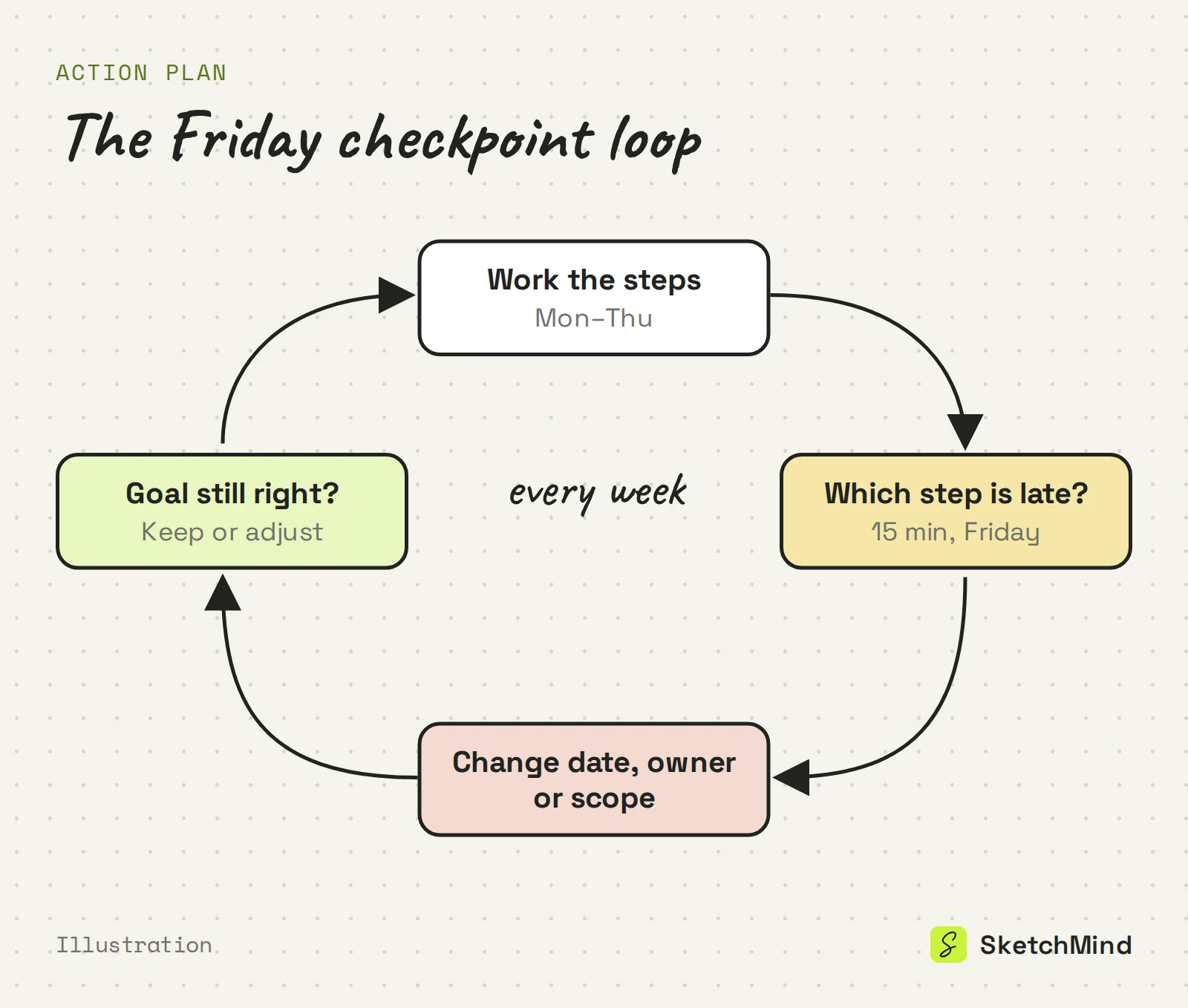
A plan that is 80% accurate and current beats one that was perfect at kickoff and untouched since. If the plan needs dates across several workstreams, the guide to creating a project timeline goes further, and a longer onboarding horizon is covered in the 30-60-90 day plan.
How to make an action plan in SketchMind
In SketchMind, an AI whiteboard, plans have their own tool. Plans is no longer a board type in Create with AI; it lives at /plans, next to Agenda, Goals and a Focus timer.
- Put the thinking on a board first. Describe the goal in Create with AI, for example "launch a monthly newsletter, first edition to 500 subscribers by October 30, three people", and choose Frames or Flow.
- Open Plans and choose "+ New plan". Start from that board, and SketchMind drafts the steps for you.
- Edit the steps, then move them to Agenda to put them on specific days, or start a Focus session of 15, 25 or 45 minutes on the next one. The Up next card offers Focus and Done for the next step.
- Write the outcome itself in Goals, which shows progress based on your agenda items.
Agenda, Goals, Focus and Plans are included on every plan, including Free. Share the source board by link (viewers are unlimited) and let owners comment on their step, with @mentions and resolved comments. AI boards are metered: Free includes 5 as a one-time allowance and Pro ($19/month) includes 20 per month.
Last updated: September 25, 2026. Checked against the current SketchMind app.
What is the difference between an action plan and a to-do list?
A to-do list is a pile of tasks; an action plan points tasks at one goal, in order, with owners and deadlines. The goal turns things you should do into the shortest path to done.
How many steps should an action plan have?
Enough that each step is finishable by one person within about a week. For most goals that is 5 to 15 steps; past 20, you are planning a project that needs phases.
What if the plan changes halfway through?
It will, and the weekly checkpoint is there for that. Change the step, the owner or the date as soon as reality moves.
What is the difference between an action plan and a project plan?
Mostly scale. An action plan is the who, what and when for one goal; a project plan usually adds budget, dependencies and several workstreams.
Can SketchMind make an action plan?
Yes, with the Plans tool at /plans. Choose "+ New plan", start from a board, and SketchMind drafts the steps; you can then move steps to Agenda or start a Focus session. Plans is included on every plan, including Free.