


Meeting minutes are a record of decisions and action items, not a transcript. How to write minutes people read, with a worked example.
Most meeting minutes are written once, sent once, and never opened again. That is not a note-taking problem, it is a format problem.
Short answer: To write meeting minutes, record the decisions made, the action items with an owner and a date on each, and the questions that stayed open, then share the write-up within a day. Minutes are a record of outcomes, not a transcript of the conversation. A useful set fits on half a page and takes five minutes to produce.
Meeting minutes are the written record of what a meeting decided and what happens next. The name comes from "minute" as in small (my-NOOT), not from the clock: minutes were originally the small, rough notes taken during a session and written up afterwards.
That origin is a good reminder of the job. Minutes exist so that people who were there remember what they agreed, and people who were not there can act without a replay. Formal bodies like boards and associations keep minutes as an official record. For everyday work meetings, the bar is lower and the format below is enough.
Five parts, and two of them do almost all the work: decisions and action items. The rest is context that makes the record usable later.
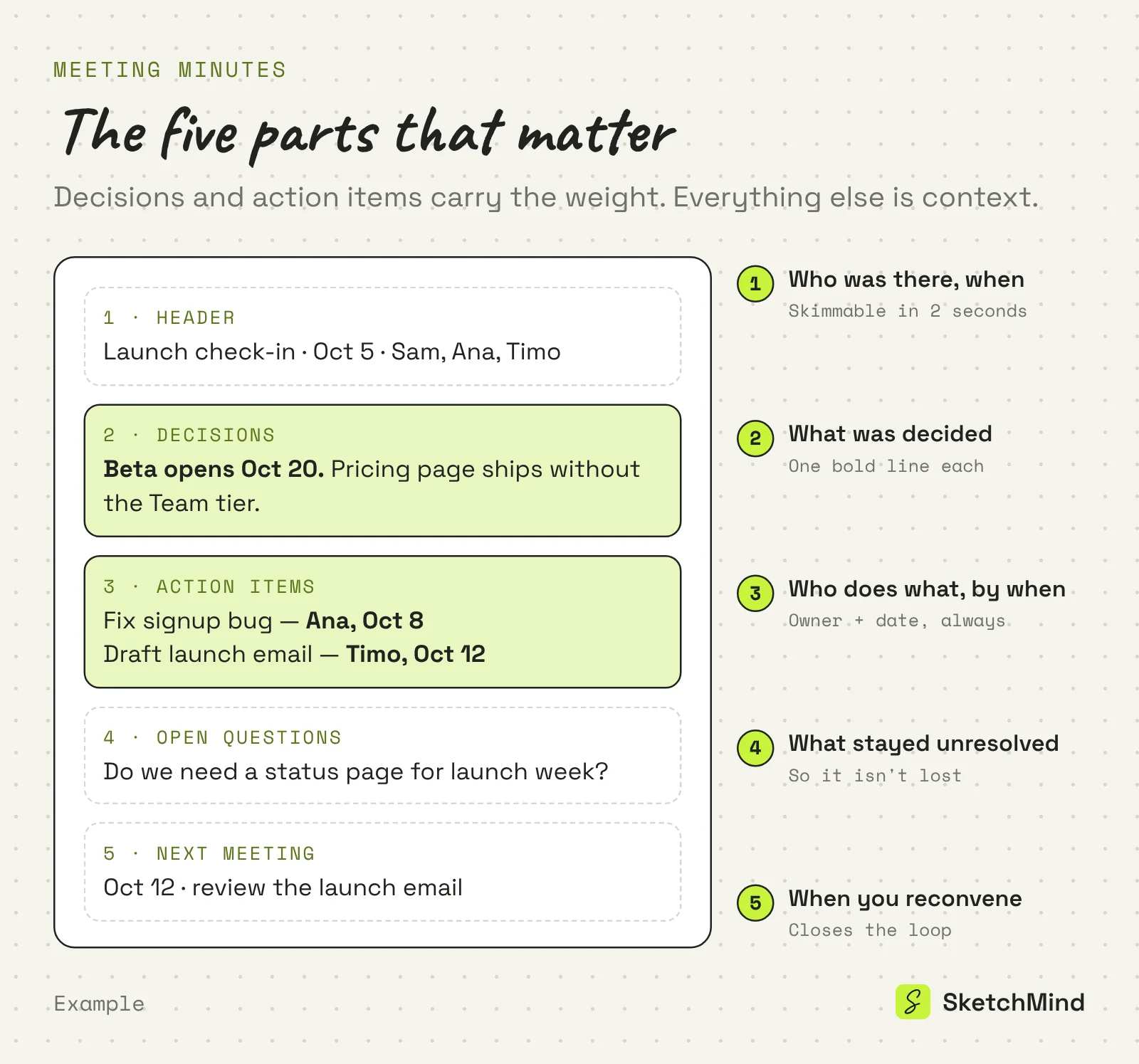
Write them during the meeting, not after it. Reconstructing decisions from memory an hour later is where most of the errors come from.
The fastest way to see the format is the same meeting written up twice. The left version records the conversation. The right version records the outcomes.
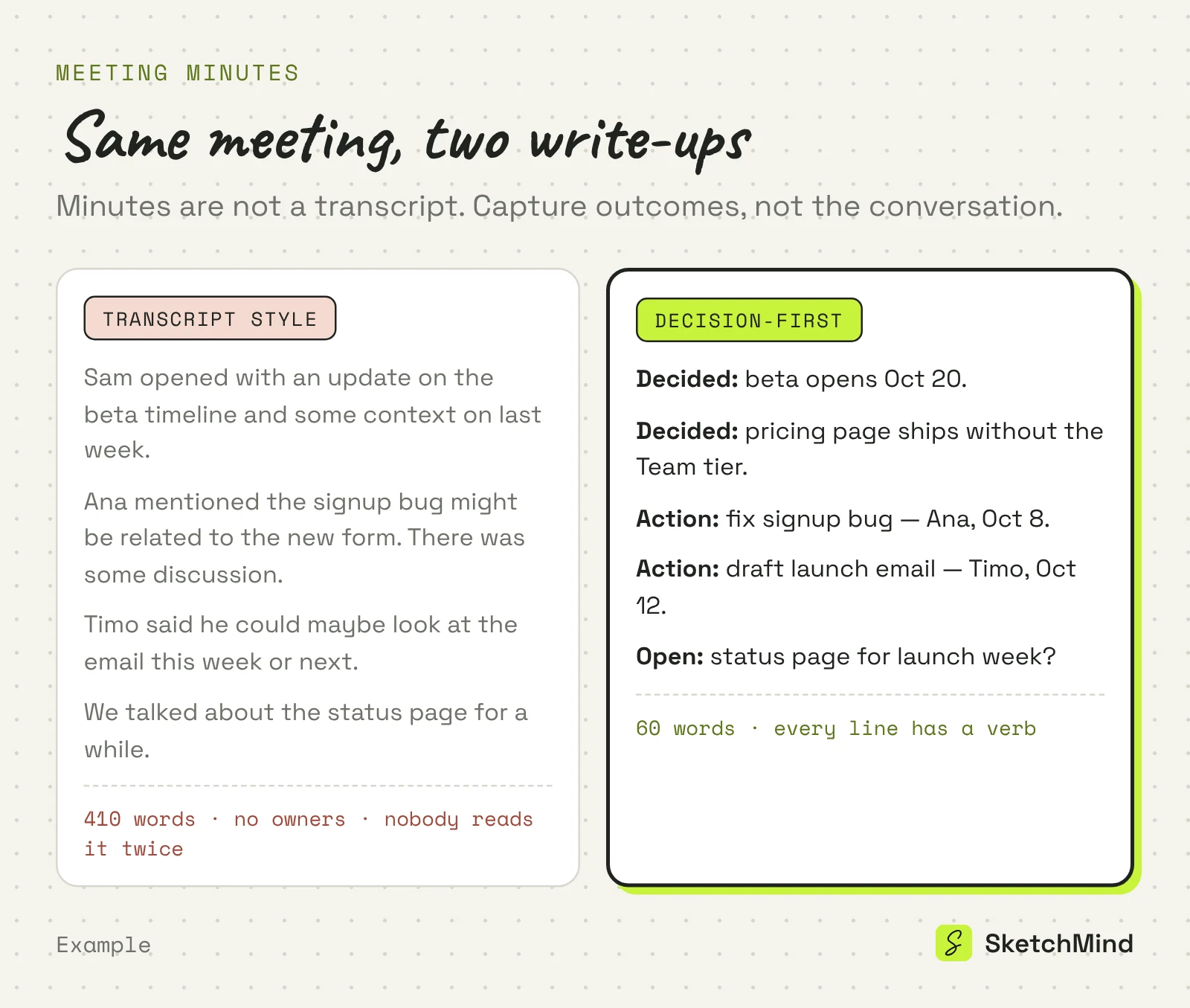
The decision-first version is not just shorter. It is checkable: next week you can walk down the action list and ask what shipped. The transcript version cannot be checked against anything.
The three documents around a meeting get mixed up constantly. They answer different questions at different moments.
The three documents around a meeting
|Document|When it is written|What it answers|
|---|---|---|
|Agenda|Before the meeting|What will we discuss, and in what order?|
|Minutes|During the meeting|What did we decide, and who does what?|
|Action plan|After the meeting|How does the work get done over time?|
Minutes sit in the middle: they consume the agenda and feed the action plan. If your minutes are good, the action plan is mostly extraction.
Anywhere people will actually look again: a shared doc, a wiki page, a pinned message. The failure mode is the same in all of them, though. The decisions survive, but the action items need to leave the document and land where work is tracked.
This is how it works in SketchMind, an AI whiteboard. If the meeting ran on a board, which frames and notes make easy, the record is already visual. The Checklist option in Create with AI turns a prompt into one editable checklist frame in about 15 seconds, so "turn today's action items into a checklist" is one sentence of typing. Items go to the Agenda with quick-add in plain language, day and time first ("Friday 14:00 review deck"), and a task can be linked to the board it came from. For minutes that need to travel, Make a document writes a document from the board's content, readable in full or as a 1 minute summary, shareable as a view link, with PDF download on Pro (3 document exports per month) and up. Comments with @mentions and a Resolve state handle the "wait, what did we mean here" follow-ups without another meeting. The Free plan includes 5 AI boards as a one-time allowance, with no credit card to start.
Wherever you keep them, the test stays the same: can someone who skipped the meeting act from your minutes alone? If yes, they are done.
Last updated: October 5, 2026. Checked against the current SketchMind app.
One named person per meeting, decided before it starts. Rotating the role works fine; improvising it at the end does not.
Half a page for most working meetings. If your minutes keep running longer, you are recording discussion instead of outcomes.
Within one working day, and same-day is better. Minutes shared a week later get skimmed once and trusted never.
For boards of directors and many associations, yes: formal minutes are part of the official record and follow stricter rules. For regular team meetings there is no requirement; the format is for usefulness, not compliance.
Notes are personal and unstructured; minutes are the shared record. The practical difference is that minutes name decisions and owners, so the group can be held to them.