


A complete SWOT analysis example for a small business, the questions that fill each quadrant, and the four crossings that turn the grid into moves.
Most SWOT guides explain the four letters and stop right where it gets useful: what a filled-in grid looks like, and what you do the morning after. Here is a complete SWOT analysis example for a small business, the questions that fill each quadrant, and the four crossings that turn the grid into decisions.
Short answer: A good SWOT analysis example lists 3 to 5 specific points per quadrant: strengths and weaknesses from inside the company, opportunities and threats from outside it. The example below analyzes a local coffee roastery weighing an online store, and ends with four moves: grow, fix first, defend and de-risk. A SWOT is finished when it names those moves, not when the four boxes are full.
A SWOT analysis is a four-box review of a company, team or plan: Strengths, Weaknesses, Opportunities and Threats. The two left letters look inward at what you control; the two right letters look outward at what the market does whether you like it or not. The format is fifty years old and survives because it fits on one page and forces one honest conversation about each box.
The common mistake is treating it as a brainstorm with labels. A brainstorm collects ideas; a SWOT sorts evidence. "We're passionate" is not a strength. "Customers drive past two supermarkets to buy from us" is.
The subject: an independent coffee roastery with a loyal local base, thinking about selling online. Three to five points per quadrant is enough; past that, you are listing instead of choosing.
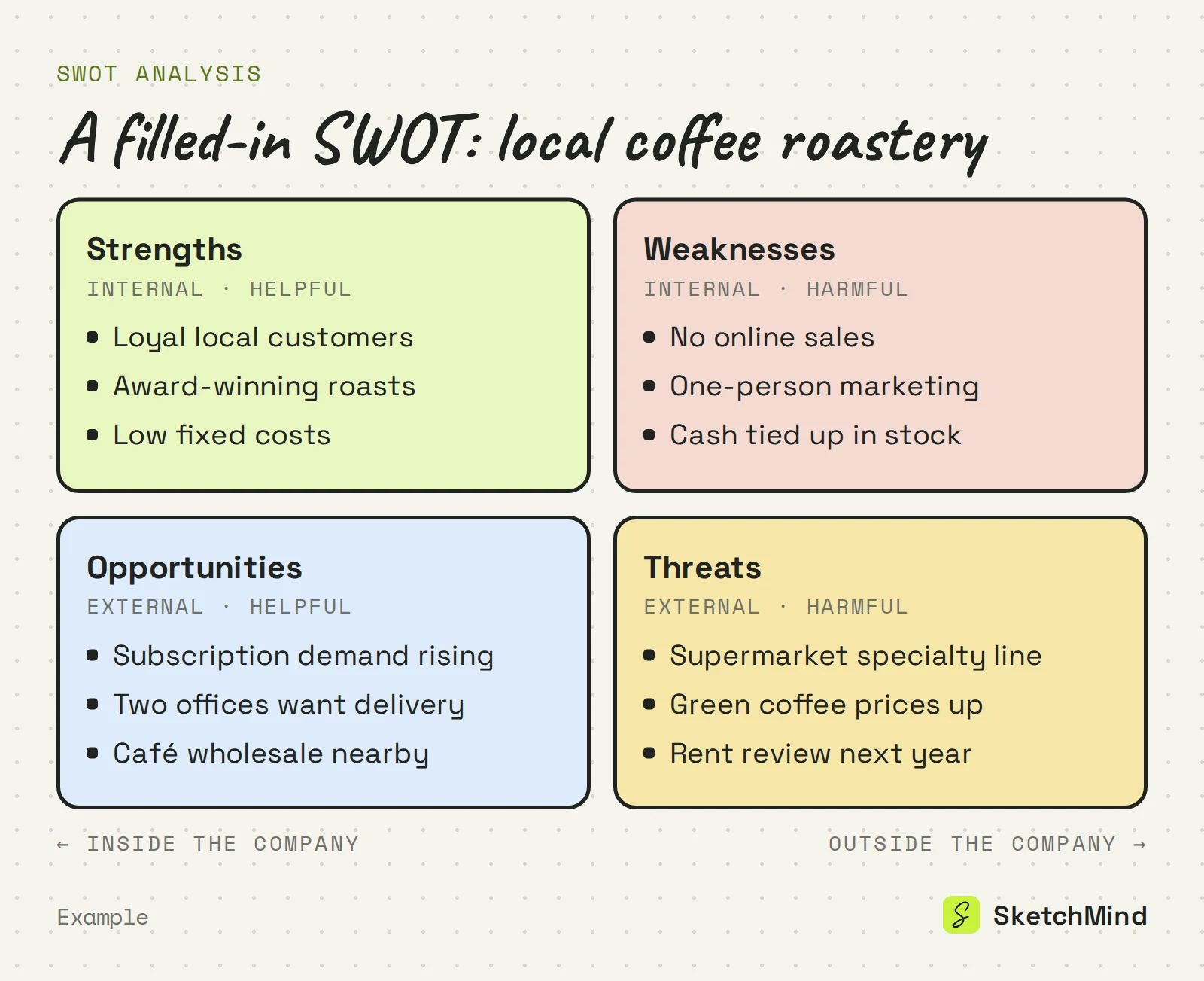
Notice what makes these points usable: each one is specific enough to argue with. "Two offices asked about delivery" can be checked. "Growing market" cannot.
Fill each quadrant by answering its own question with evidence, not adjectives.
The question behind each quadrant
|Quadrant|Ask|Weak answer|Strong answer|
|---|---|---|---|
|Strengths|What do customers choose us for?|"Great quality"|"Award-winning roasts"|
|Weaknesses|Where do we lose time or money?|"Marketing"|"One person does all marketing"|
|Opportunities|What is changing out there in our favor?|"E-commerce"|"Two offices want weekly delivery"|
|Threats|What could hurt us that we don't control?|"Competition"|"Supermarket specialty line"|
Two sorting rules settle most arguments. If you can change it by deciding to, it is internal: strength or weakness. If it would still happen with a different team in charge, it is external: opportunity or threat. A collection method for the raw input is covered in brainstorming templates.
Cross the columns. Each inside column paired with each outside column produces one kind of move, which is why a SWOT should end as a list of four actions:
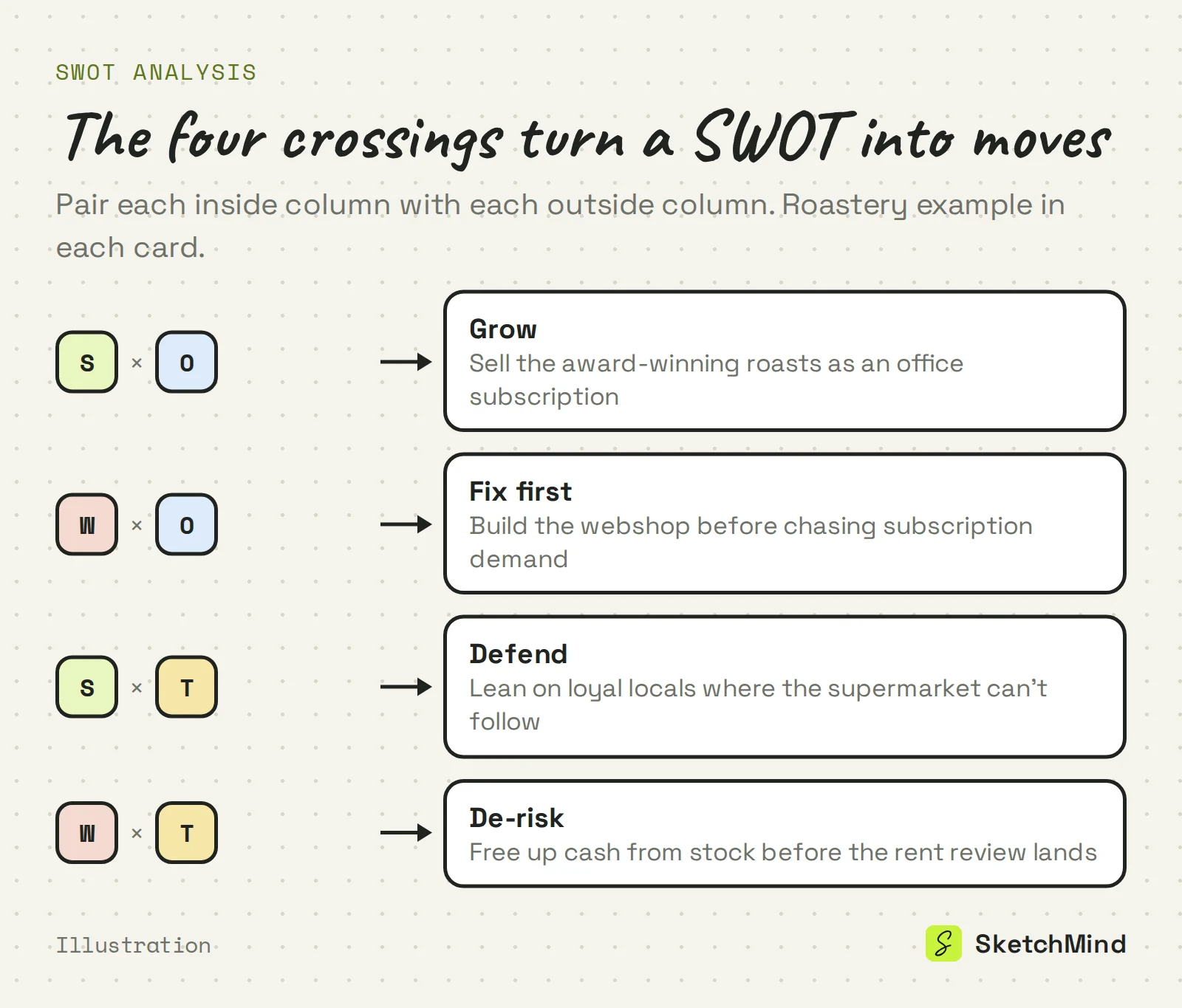
Each move then needs an owner and a date to become real work; the action plan example shows that step.
A SWOT analysis template needs five parts: the four quadrants plus a row for the moves that come out of the crossings. That fifth part is what most downloadable templates miss, and it is the part that makes the exercise worth an hour of four people's time. The grid itself is the easy 20 minutes; without the moves row, the result is a tidy poster.
In SketchMind, an AI whiteboard, a SWOT fits the Frames output of Create with AI: one frame per quadrant plus the moves.
The Free plan includes 5 AI-generated boards as a one-time allowance, so the first SWOT costs nothing to try.
Last updated: October 1, 2026. Checked against the current SketchMind app.
Strengths, Weaknesses, Opportunities and Threats. Strengths and weaknesses are internal, things the company controls; opportunities and threats are external, things the market does regardless.
Three to five specific points. Past that you are listing instead of choosing, and the moves that follow get vaguer, not better.
A strength already exists inside the company, like a loyal customer base. An opportunity is an outside change you could catch, like rising subscription demand. The test: would it still be there with a different team in charge?
Cross the columns into four moves: grow (strengths × opportunities), fix first (weaknesses × opportunities), defend (strengths × threats) and de-risk (weaknesses × threats), then give each move an owner and a date.
Yes. Open Create with AI, pick Frames and describe the company; you get 4–8 editable frames on your board in about 40 seconds, with one PDF (up to 5 MB) or up to 3 links as optional context.