


Scope of work template: the six sections that stop scope creep
A scope of work template with six sections: summary, deliverables, out of scope, timeline, acceptance criteria and sign-off. With an example.
- A scope of work fixes what a project delivers, by when, and what counts as done, before anyone starts.
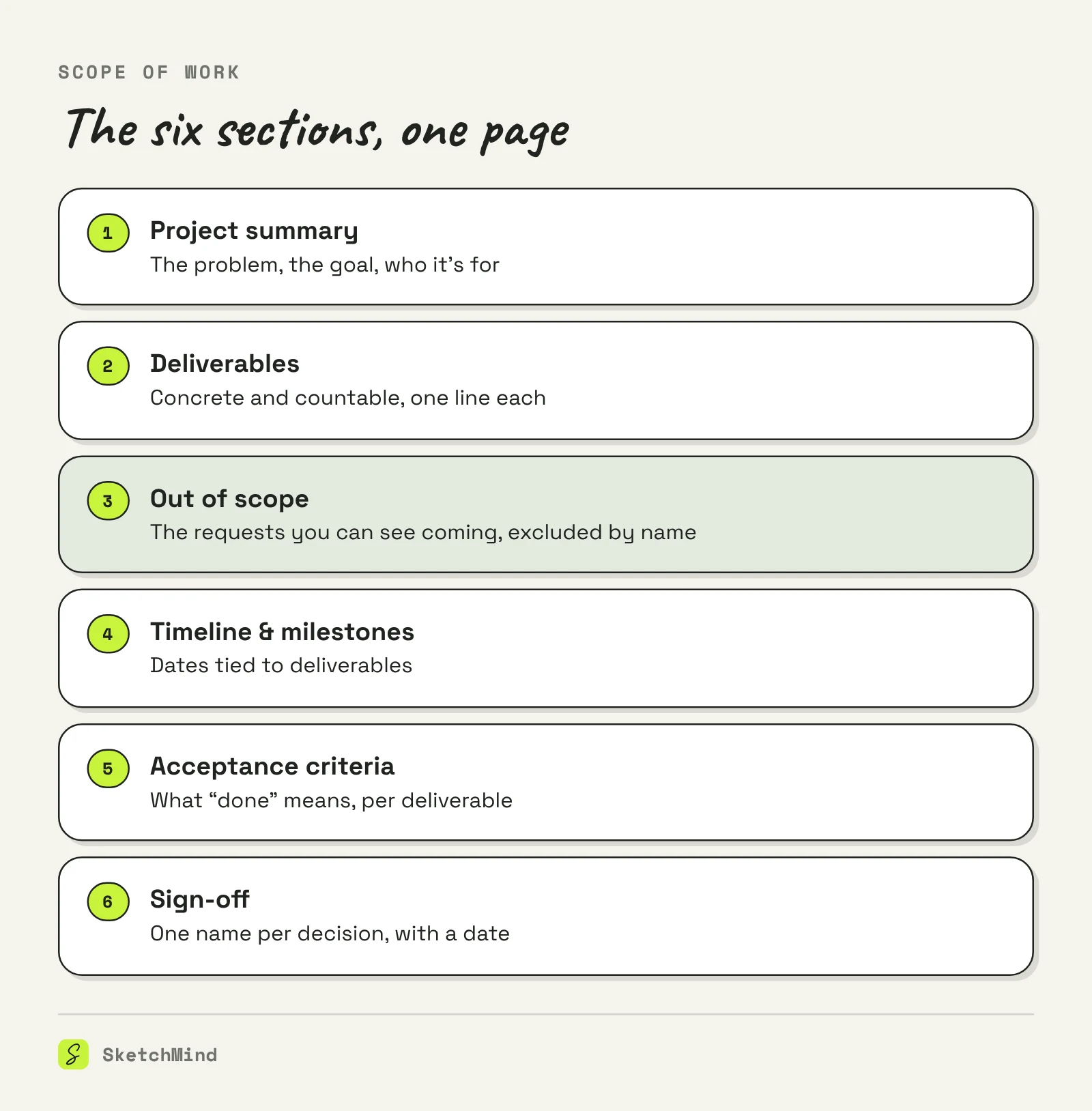
- Six sections do the work: project summary, deliverables, out of scope, timeline with milestones, acceptance criteria and sign-off.
- Deliverables must be countable: "a five-page website" survives a dispute, "a modern web presence" does not.
- Scope creep is ten small requests, not one big one; route every new request through one fixed change rule.
- In SketchMind, the scope can live on the project board and become a shareable document that flags when the board changed.
Projects rarely blow up because the work was hard. They blow up because two people had two different projects in their head, and nobody wrote down which one was real. A scope of work fixes that before anyone starts.
Short answer: A scope of work template has six sections: a project summary, the deliverables, what is out of scope, the timeline with milestones, acceptance criteria, and sign-off. Fill in all six before work starts, and make the out-of-scope section as specific as the deliverables. One page is usually enough.
What is a scope of work?
A scope of work is a short document that defines what a project will deliver, by when, and what counts as done. It is the reference both sides point to when someone asks for "one small extra thing" in week four.
It is not a contract and not a project plan. The contract covers payment and liability; the plan covers who does what on which day. The scope of work sits between them: it fixes the boundaries of the work itself.
What goes in a scope of work template?
Six sections do the work. If one is missing, you will feel it later.
- Project summary. Two or three sentences: the problem, the goal, and who it is for. Anyone reading only this should understand why the project exists.
- Deliverables. The concrete things that will be handed over, each one countable. "A five-page website" survives a dispute; "a modern web presence" does not.
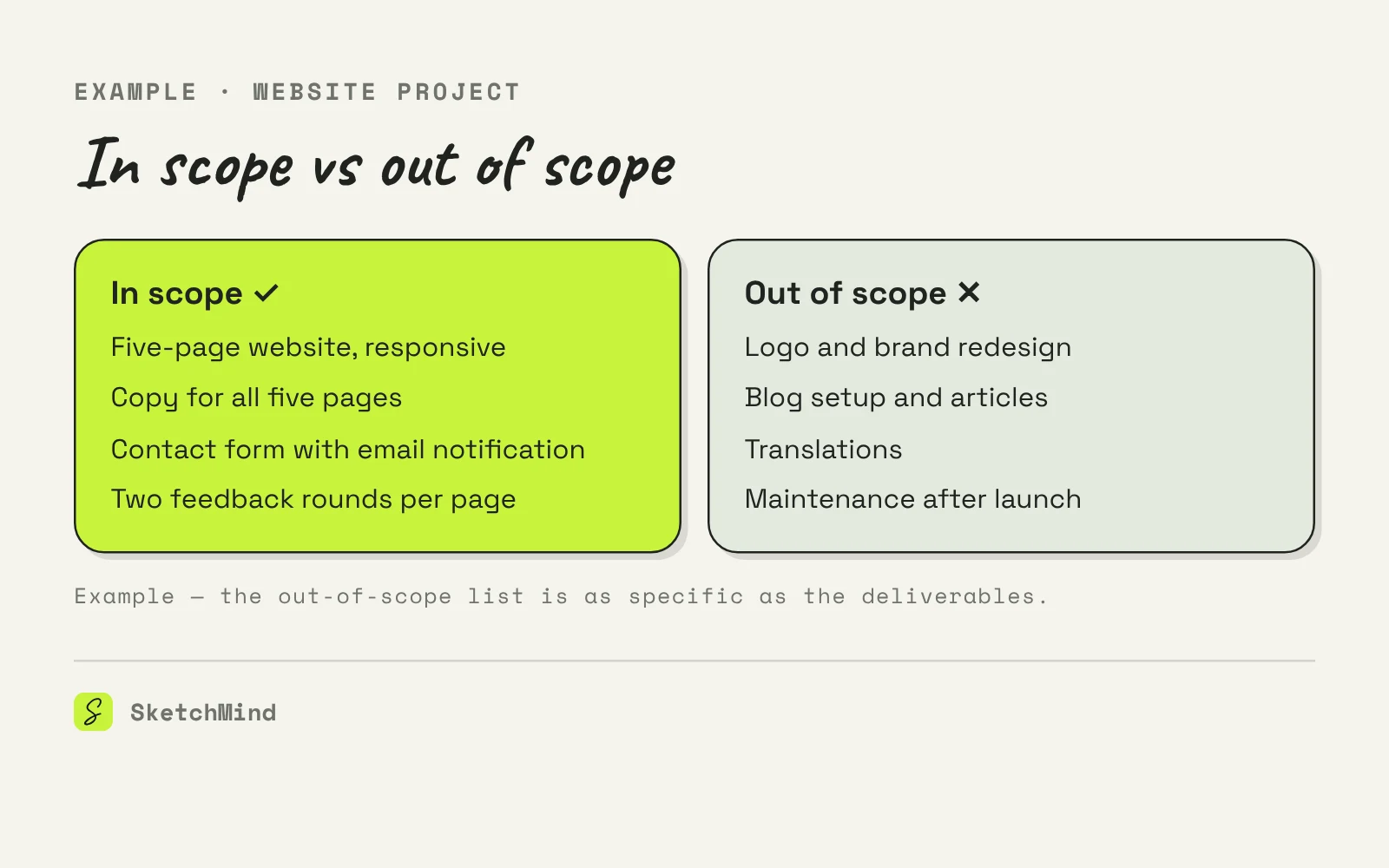
- Out of scope. The requests you can already see coming, named and excluded. This section prevents more arguments than the other five combined.
- Timeline and milestones. Dates for the moments that matter: kickoff, first draft, review, delivery. Tie each milestone to a deliverable, not to a feeling of progress.
- Acceptance criteria. How the client or stakeholder will judge that a deliverable is done. A checklist per deliverable works better than a paragraph.
- Sign-off. Who approves, and what their approval means. One name per decision, with a date.
How is a scope of work different from a brief or a project plan?
The three documents answer different questions, and teams get into trouble when one is asked to do another one's job.
Three documents, three jobs
|Document|What it fixes|When it is written|
|Scope of work|What will be delivered, and what will not|Before work starts, signed by both sides|
|Creative brief|Why the work exists and what good looks like|Before the first draft|
|Project plan|Who does what, in which order, by when|After the scope is agreed|
A creative brief feeds the scope of work; the scope of work feeds the plan. Writing them in that order means each document stays one page.
How do you write a scope of work?
- Start from the conversation, not from a blank template. Write down what was actually promised in the sales call or kickoff, in plain sentences.
- Turn every promise into a countable deliverable. If you cannot count it, rewrite it until you can.
- List the three requests you expect but will not do, under "out of scope". Be as concrete there as in the deliverables.
- Put a date on each milestone and a name on each sign-off.
- Send it before the first day of work, and get a written yes.
How do you stop scope creep after sign-off?
Scope creep is rarely one big request. It is ten small ones, each too minor to refuse. The defence is mechanical, not personal: when a new request lands, check it against the deliverables list. If it is not there, it goes through one fixed route, usually "we add it to a change list and price it separately". The out-of-scope section makes that conversation short, because the request is often already named there.
Where should a scope of work live?
In SketchMind, an AI whiteboard, the scope can live next to the project instead of in an attachment nobody reopens. Describe the project in Create with AI, in up to 3,000 characters, or attach the client's brief as a PDF of up to 5 MB; the result is written from it. A table frame holds the deliverables with dates, and the board is shared by link, so the scope stays in sight during the work it governs.
When the scope needs to be a document, "Make a document" writes one from the board's sections, readable in full or as a 1-minute summary, with a share link anyone can open. Documents you write yourself are included on every plan; AI document exports to PDF are included from Pro ($19 per month, 3 per month). If the board changes after the document was written, the document says so and offers one Update button, which is exactly what you want a scope to do when a milestone moves.
Last updated: October 29, 2026. Checked against the current SketchMind app.
What is the difference between a scope of work and a statement of work?
A statement of work is usually the formal, often contractual document; the scope of work is the part that defines the work itself. Many teams use the terms interchangeably. What matters is that deliverables, exclusions, milestones and sign-off are written down.
How long should a scope of work be?
One page for most projects. If it grows past two, the project probably needs splitting, or the detail belongs in the project plan instead.
Who writes the scope of work?
The side doing the work writes it, because they carry the cost of ambiguity. The client confirms it in writing before work starts.
Can SketchMind generate a scope of work?
You describe the project in Create with AI, up to 3,000 characters with an optional PDF of up to 5 MB as context, work through the sections on the board, and write it up with "Make a document". Documents you write yourself are included on every plan.
What belongs in the out-of-scope section?
The requests you can already predict: extra feedback rounds, new audiences, maintenance, translations. Name them as concretely as the deliverables.