

OKR examples for product, marketing, sales and personal goals, plus the test that separates key results from tasks.
Most OKR documents are rewritten goals with new labels. The difference between those and OKRs that work is visible in one place: whether the key results can be scored without a meeting.
Short answer: Good OKR examples share one shape: a qualitative objective that sets direction, and two to four key results that each contain a number. "New customers understand the product without our help" is an objective; "onboarding completion goes from 54% to 75%" is a key result. If a colleague could not score it at quarter's end without asking you anything, it is not a key result yet.
An OKR (Objectives and Key Results) is a goal-setting format that pairs one ambitious, qualitative objective with a small set of measurable key results that prove whether you reached it. The objective answers "where are we going", the key results answer "how will we know we arrived". Most teams set OKRs per quarter and score them from 0 to 1 at the end.
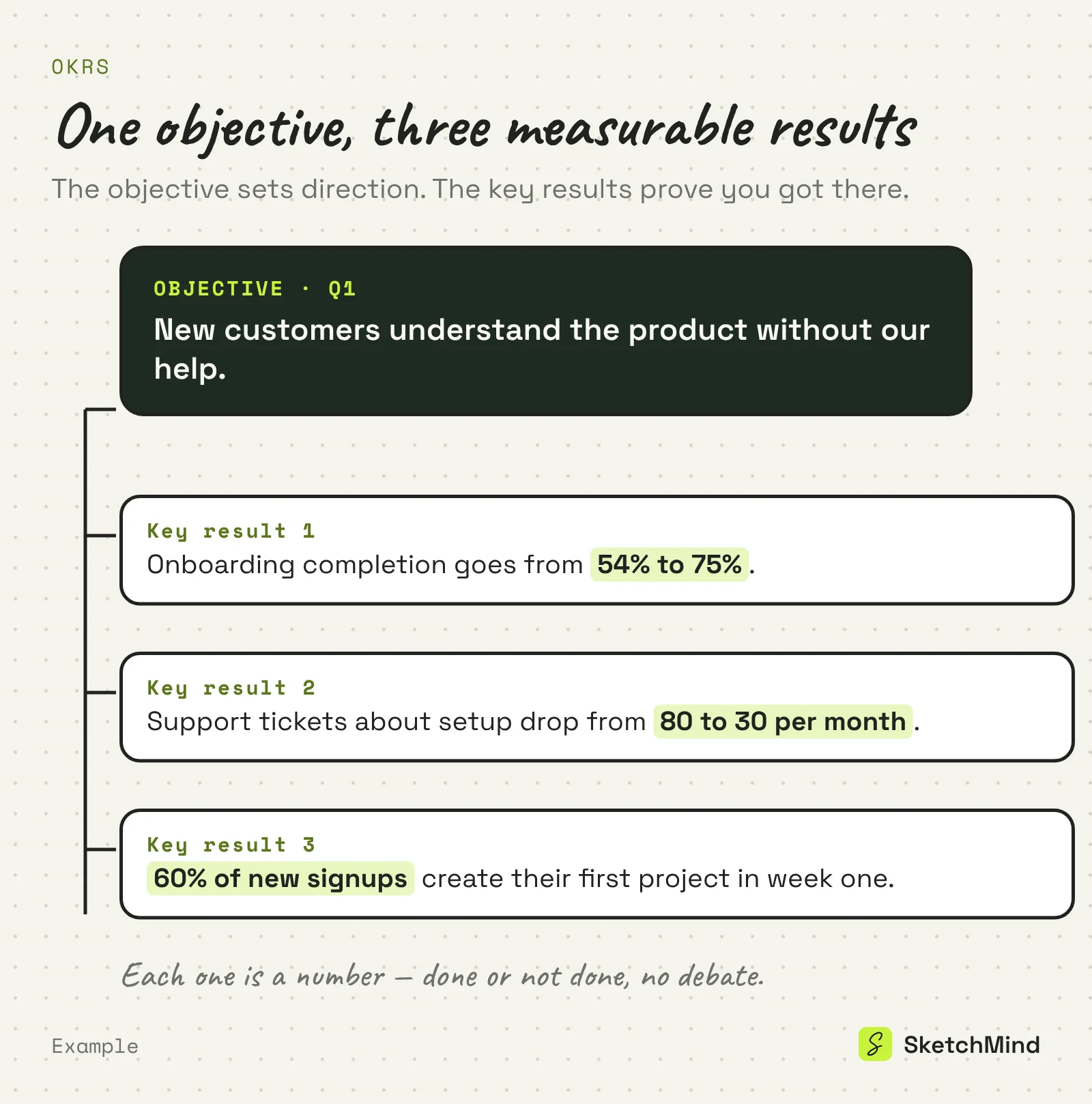
A good OKR reads like a bet, not a to-do list. The objective is short and slightly uncomfortable; the key results are outcomes you can count, not activities you can check off. "Ship the new onboarding flow" is a task. "Onboarding completion goes from 54% to 75%" is a result the task should cause. Here are four examples in that shape, one per team.
OKR examples by team
|Team|Objective|One key result|
|---|---|---|
|Product|New customers understand the product without our help|Onboarding completion 54% → 75%|
|Marketing|Our content earns trials, not just traffic|Trial signups from blog 90 → 220 per month|
|Sales|Win deals on fit, not on discount|Average discount drops from 18% to 8%|
|Personal|Become the person who ships side projects|Publish 3 finished projects by December 31|
Each objective could carry two or three more key results. Two to four is the working range: one number can be gamed, five means nobody remembers them.
Start from the vague ambition and force a number into it. The test is always the same: could someone else score this at the end of the quarter without asking you a single question?

The same four mistakes show up in most first attempts. Key results that are tasks in disguise ("launch the campaign" instead of what the campaign should move). Objectives that are metrics ("grow MRR 20%" is a key result wearing an objective's clothes). Sandbagging, where every key result is a number the team would hit anyway. And set-and-forget, where the OKRs are written in January and reread in April. The fix for the last one is structural: the key results need to live where the weekly work happens, not in a slide deck.
Keep the objective visible next to the tasks that serve it, and let progress come from finished work rather than status meetings. In SketchMind, an AI whiteboard, the Goals page holds outcomes as short, mid or long term with an optional target date, and progress fills in from the agenda tasks you link to each goal. You can add a task for a goal directly or link an existing one, and when you draft a plan in Plans, it creates its own goal so the steps and the outcome stay connected. Agenda, Goals and Focus are included on every plan. For the quarter-length version of this, a 30-60-90 day plan covers the same ground for one person instead of a team.
Last updated: October 12, 2026. Checked against the current SketchMind app.
Objectives and Key Results. The objective is a qualitative direction, the key results are the measurable outcomes that prove you reached it.
Two to four. One number can be gamed, and five means nobody remembers them.
A KPI is a metric you watch continuously, like uptime or churn. An OKR is a time-boxed bet to change something, with key results that often move a KPI from a baseline to a target.
The objective sets direction and contains no number. Each key result contains a number with a baseline and a target, so it can be scored.
Most teams score each key result from 0 to 1 at the end of the quarter. Around 0.7 on an ambitious key result is usually considered a good outcome.