

What a team charter is, the six sections that belong in it, how to write one in a single session, and how to keep it alive after week one.
Most teams settle how they work in week one, out loud, and then spend months re-arguing it. A team charter puts that agreement on paper so the argument happens once.
Short answer: A team charter is a short document a team writes together that records why the team exists, who is on it and in what role, how decisions get made, and how people communicate. A good team charter fits on one page, takes about an hour to write as a group, and ends the recurring debates about ownership and ways of working.
A team charter is the team's written agreement about purpose and ways of working, made at the start and kept current. It answers the questions that otherwise come back every few weeks: what are we here to do, who decides, what does "done" mean, and where do we talk about what.
It is not a project plan. A plan says what happens next sprint; a charter says how the team behaves in every sprint. It is also not an org chart: reporting lines live in HR tools, while the charter records working roles the team actually uses day to day.
Six sections cover almost every team. Keep each one to a few lines.
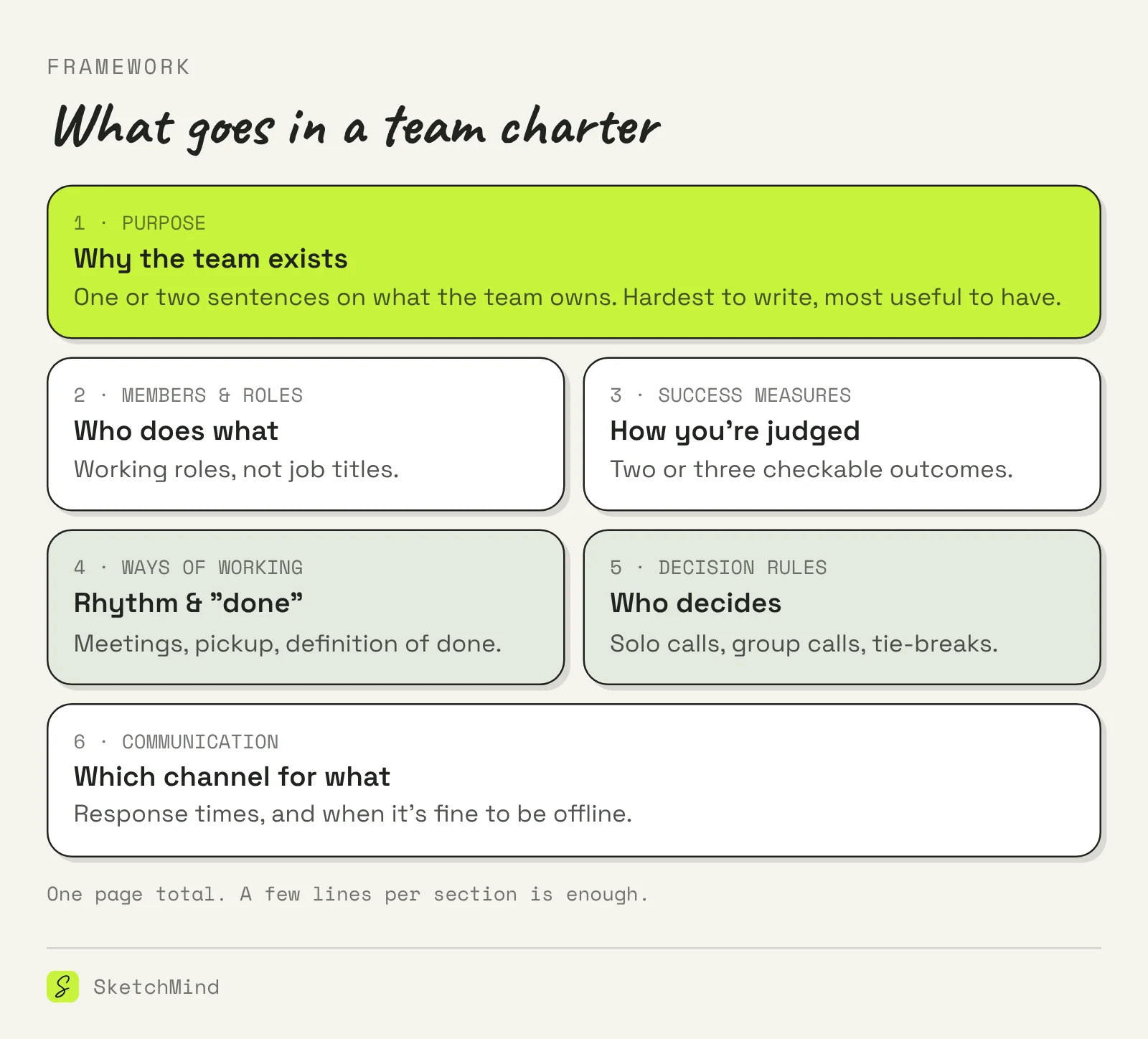
Write it with the team in one working session, not alone at a desk. A charter nobody helped write is a charter nobody follows.
A team charter describes a standing team; a project charter describes one piece of work with an end date. Teams often need both, and they stay short because each answers different questions.
Three documents, three jobs
|Document|Describes|Ends when|
|---|---|---|
|Team charter|How a standing team works|The team changes or disbands|
|Project charter|Scope, budget and timeline of one project|The project ships|
|RACI chart|Who does what on specific activities|The activities change|
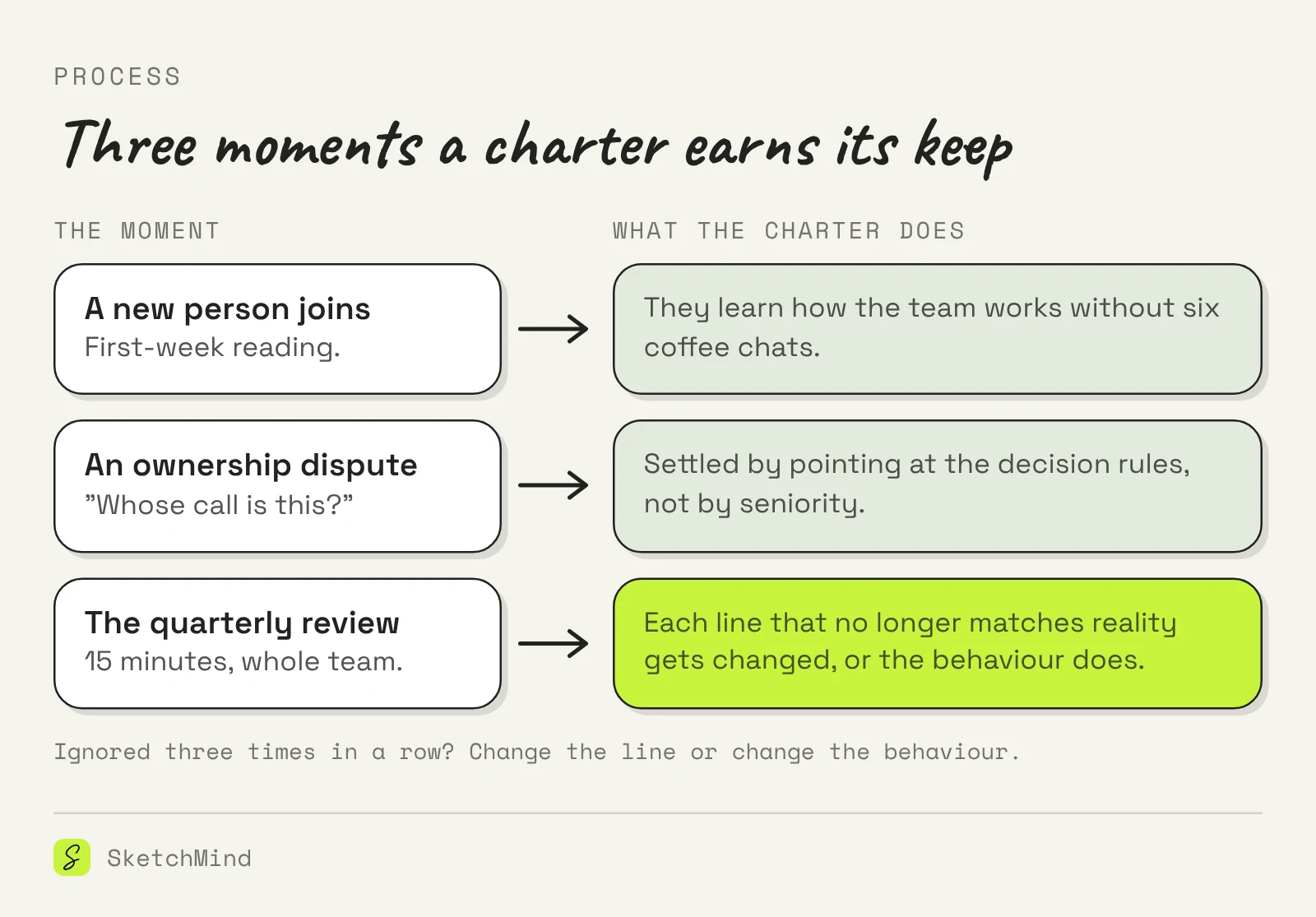
A charter stays alive by being used at specific moments, not by being re-read on a schedule. Three triggers do most of the work: a new person joins and reads it in their first week, a disagreement about ownership gets settled by pointing at it, and a quarterly review asks which line no longer matches reality. If a line is ignored three times in a row, change the line or change the behaviour; a charter that contradicts practice is worse than none.
Keep the charter where the team already works, so it gets pointed at instead of forgotten. In SketchMind, an AI whiteboard, you can describe your team in the Create with AI dialog, pick Frames, and get 4–8 editable frames on your board in about 40 seconds: one frame per charter section, ready to edit in the session itself. The board is shared by link with unlimited viewers on every plan, so the charter is one click away from any discussion it needs to settle. Comments with @mentions sit on the board and can be resolved, which suits the quarterly review: each proposed change becomes a comment, and the ones the team accepts get edited in. The Free plan includes 5 AI boards as a one-time allowance with 2 editors per board, which is enough to try the charter session on a real team.
Last updated: October 19, 2026. Checked against the current SketchMind app.
One page. Six sections of a few lines each is enough; anything longer stops being read and starts being archived.
The whole team, in one working session. One person can tidy the wording afterwards, but the content should come from the group, or it will not be followed.
Review it quarterly in about 15 minutes, and immediately when membership or the team's scope changes. Change any line that no longer matches how the team actually works.
They overlap. A team contract usually stresses the commitments members make to each other; a charter adds purpose and success measures on top of those agreements.
From about three people it starts paying off. A pair can usually keep it to two sections: decision rules and communication agreements.