

What R, A, C and I mean, five steps to make a RACI chart, and a filled-in example with exactly one accountable owner per task.
Half the delays in a project trace back to a question nobody asked out loud: who actually owns this? A RACI chart answers that question before the work starts.
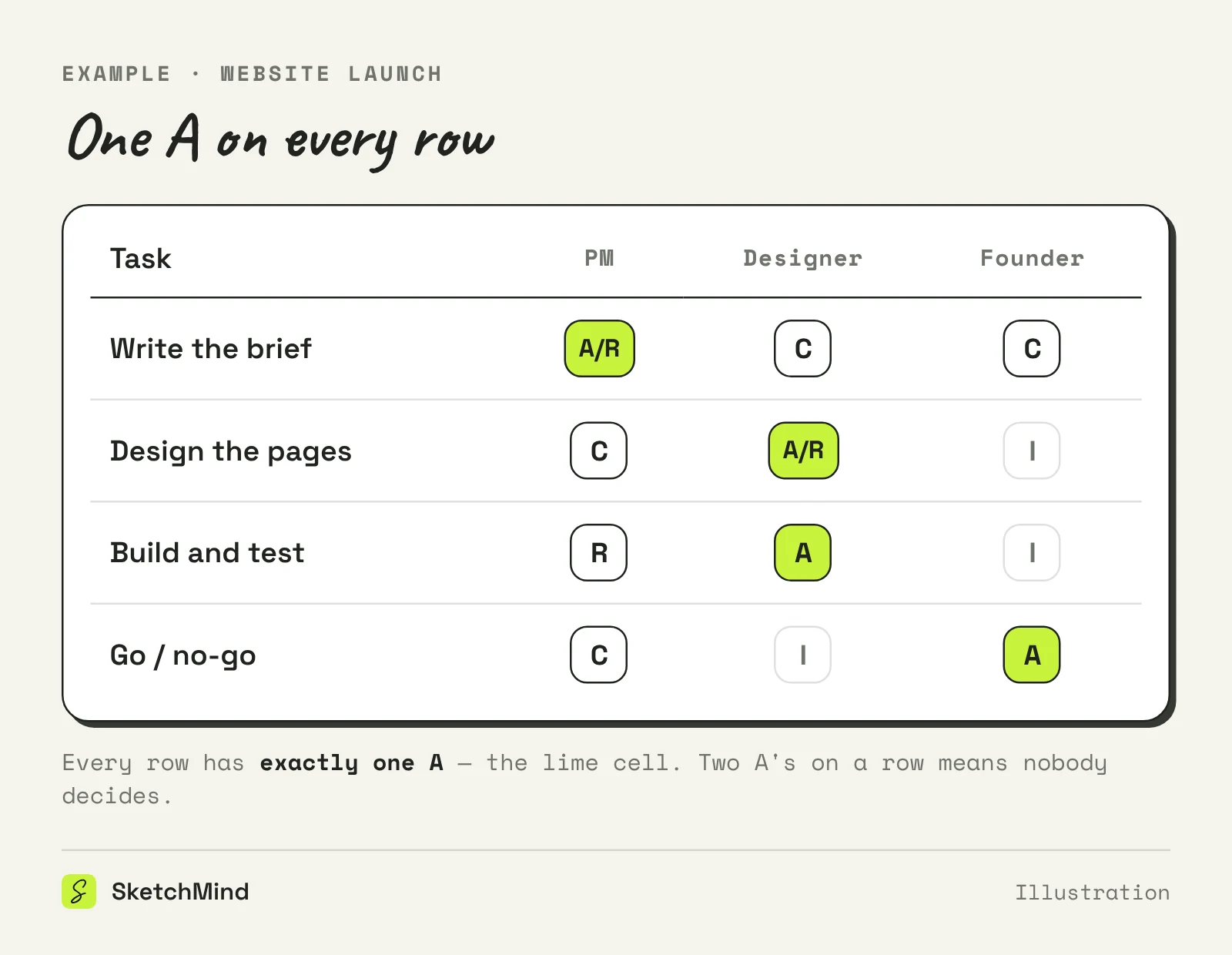
Short answer: A RACI chart is a table that maps the tasks in a project against the people involved and marks each person as Responsible, Accountable, Consulted or Informed. Every row gets exactly one Accountable owner, so every task has one person who answers for the outcome. You can build a RACI chart in minutes: list the tasks down the side, the people across the top, and fill in the letters.
A RACI chart (also called a RACI matrix) is a responsibility grid: tasks in rows, people or roles in columns, and in each cell a letter that says what that person has to do with that task. It exists because "the team owns it" is how tasks fall on the floor. The chart forces one uncomfortable, useful conversation per row: who, exactly, is on the hook here?
You need one when more than three people touch the same piece of work, when two teams share a deliverable, or when a project keeps stalling on decisions nobody feels entitled to make. For a two-person project, skip it: you both already know.
The four letters describe four different relationships to a task:
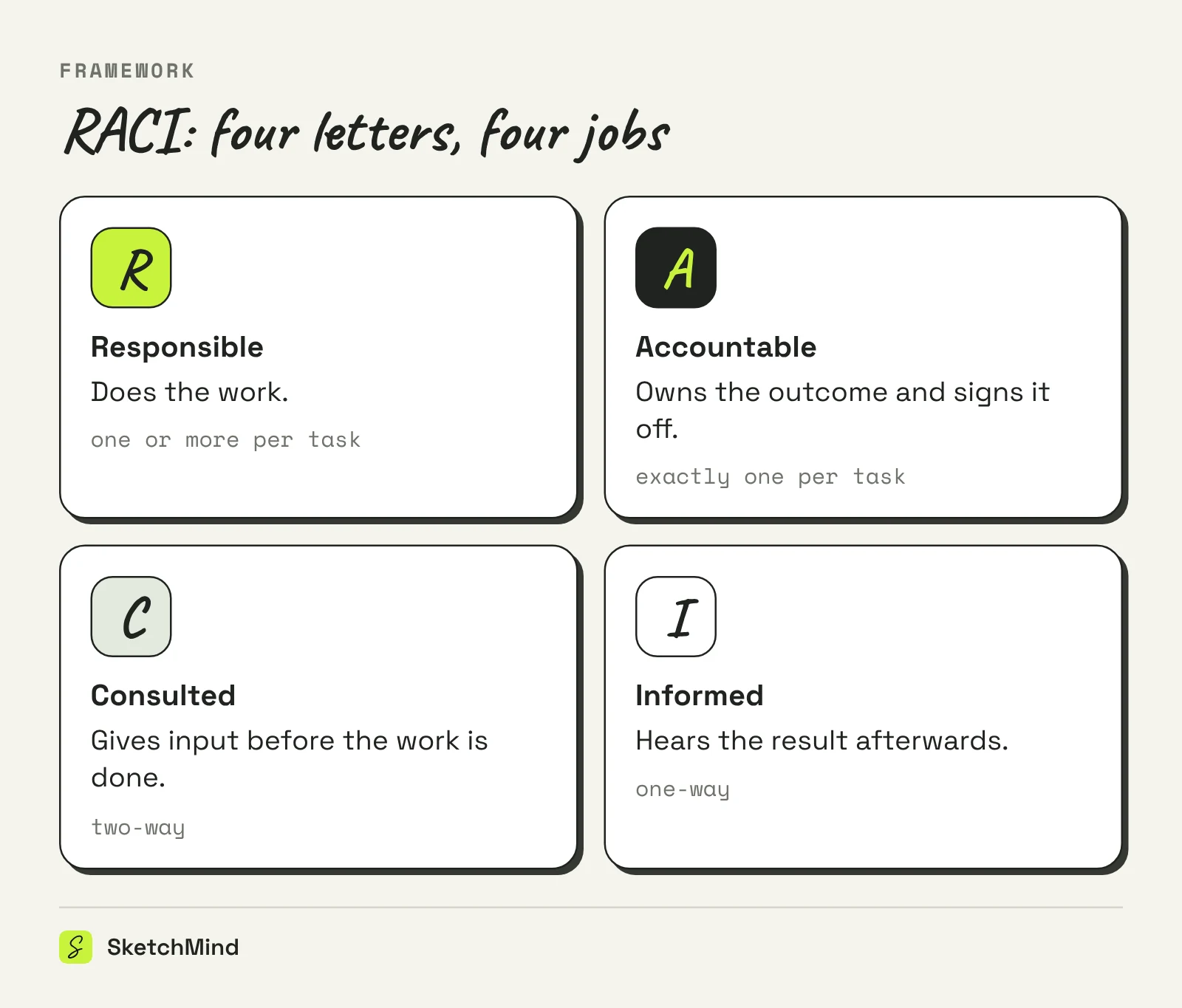
The distinction people miss most often is C versus I. Consulted happens before the work and changes it; Informed happens after and doesn't. Mark someone C who only needs an I and you have added a review loop that slows every task down.
Five steps, in order:
The same few mistakes account for most RACI charts that quietly stop being used:
RACI has variants. The differences are smaller than the acronyms suggest:
Three ways to slice the same idea
|Model|Letters|Best for|
|---|---|---|
|RACI|Responsible, Accountable, Consulted, Informed|Most projects; the default|
|RASCI|Adds S for Support|Work with dedicated helpers who are not fully responsible|
|DACI|Driver, Approver, Contributors, Informed|Decisions rather than tasks|
If you are unsure, use RACI. The value is in the conversation per row, not in the acronym.
A RACI chart only works if it sits where the project is discussed, not in a document nobody reopens. In SketchMind, an AI whiteboard, the chart lives on the project board itself: draw it with the Table tool on the canvas, next to the frames that hold the plan. When ownership is contested, a positional comment with an @mention puts the question on the exact row, and Resolve closes it when the row is settled. Share works by link, with unlimited viewers on every plan, so the people marked I can check the chart without an account seat; editing is for 2 editors per board on Free and 3 on Pro. If the project itself still needs shaping first, describe it in the composer and Create frames returns 4–8 editable frames on your board in about 40 seconds; the RACI table then hangs next to a plan people can actually read.
For what a task list with owners looks like beyond the letters, see our action plan example; if the project runs in sprints, the sprint planning template covers the five fields that make a sprint real.
Last updated: October 15, 2026. Checked against the current SketchMind app.
Responsible, Accountable, Consulted and Informed: the four relationships a person can have to a task. Responsible does the work, Accountable owns the outcome, Consulted gives input beforehand, Informed hears the result afterwards.
Yes. On small teams it is common; mark the cell A/R. The rule that matters is that no task has more than one Accountable.
More than one is fine, as long as the single Accountable person signs off the combined result.
For teams of two or three people who already know who owns what. RACI pays off when several people or two teams share deliverables and decisions keep stalling.
RASCI adds an S for Support: people who help the Responsible person without owning the work. Use it only if that distinction solves a real argument; otherwise RACI is enough.