


A ten-minute method for prioritizing tasks: sort by urgent and important, pick a top three for today, and keep the list honest.
Most task lists do not fail because people are lazy. They fail because everything on them looks equally important, so the loudest task wins the day.
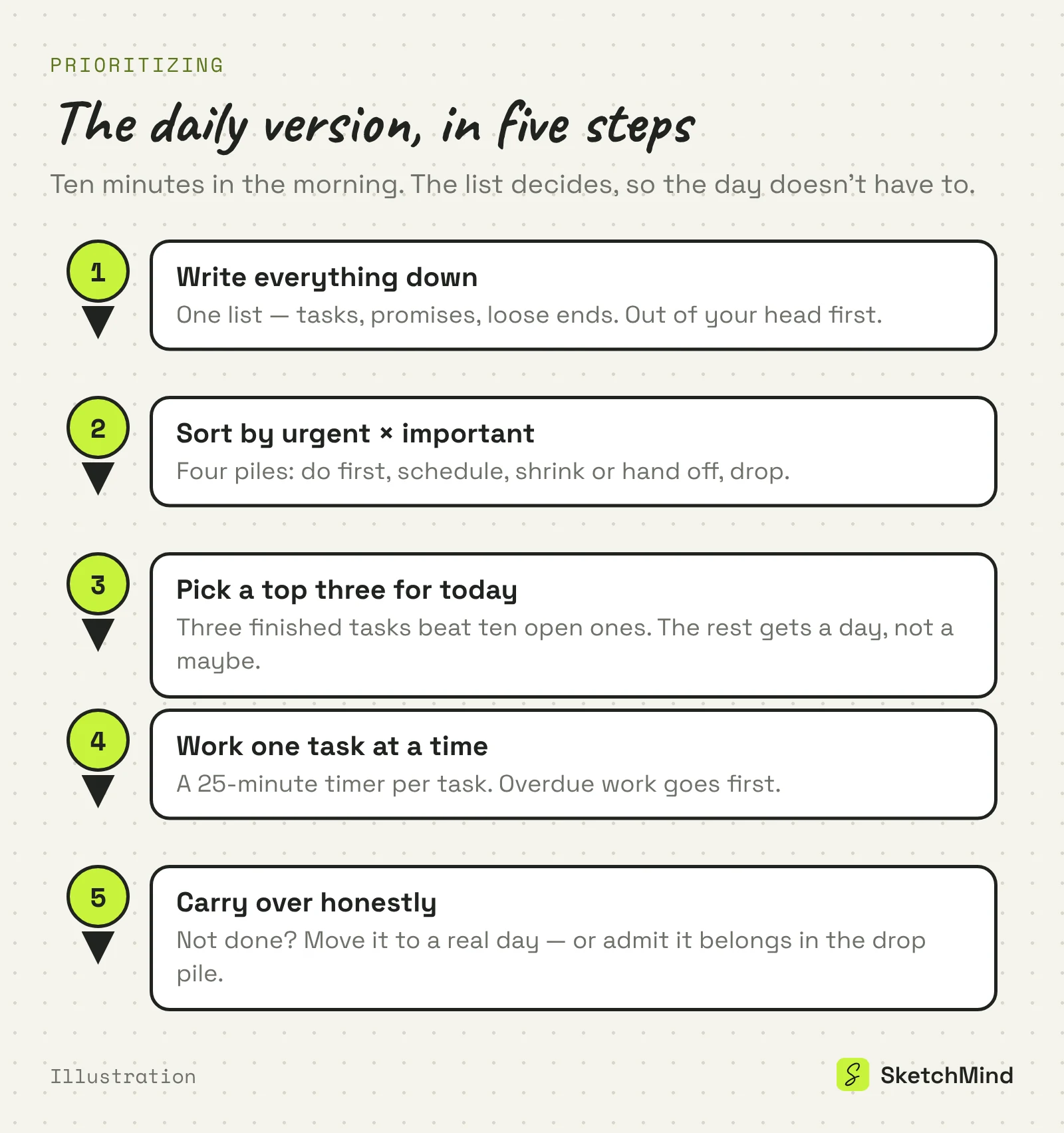
Short answer: To prioritize tasks, write everything into one list, sort each task by urgency and importance, and pick no more than three tasks to finish today. Give everything else a concrete day or drop it. Repeat the sort every morning in about ten minutes, because priorities shift faster than lists do.
Prioritizing tasks means deciding the order in which work gets done, based on consequences rather than noise. A prioritized list answers one question: if today goes wrong and you only finish one thing, which thing keeps its full value? Everything after that is sequencing. Without that decision, the order of your day is set by whoever emailed last.
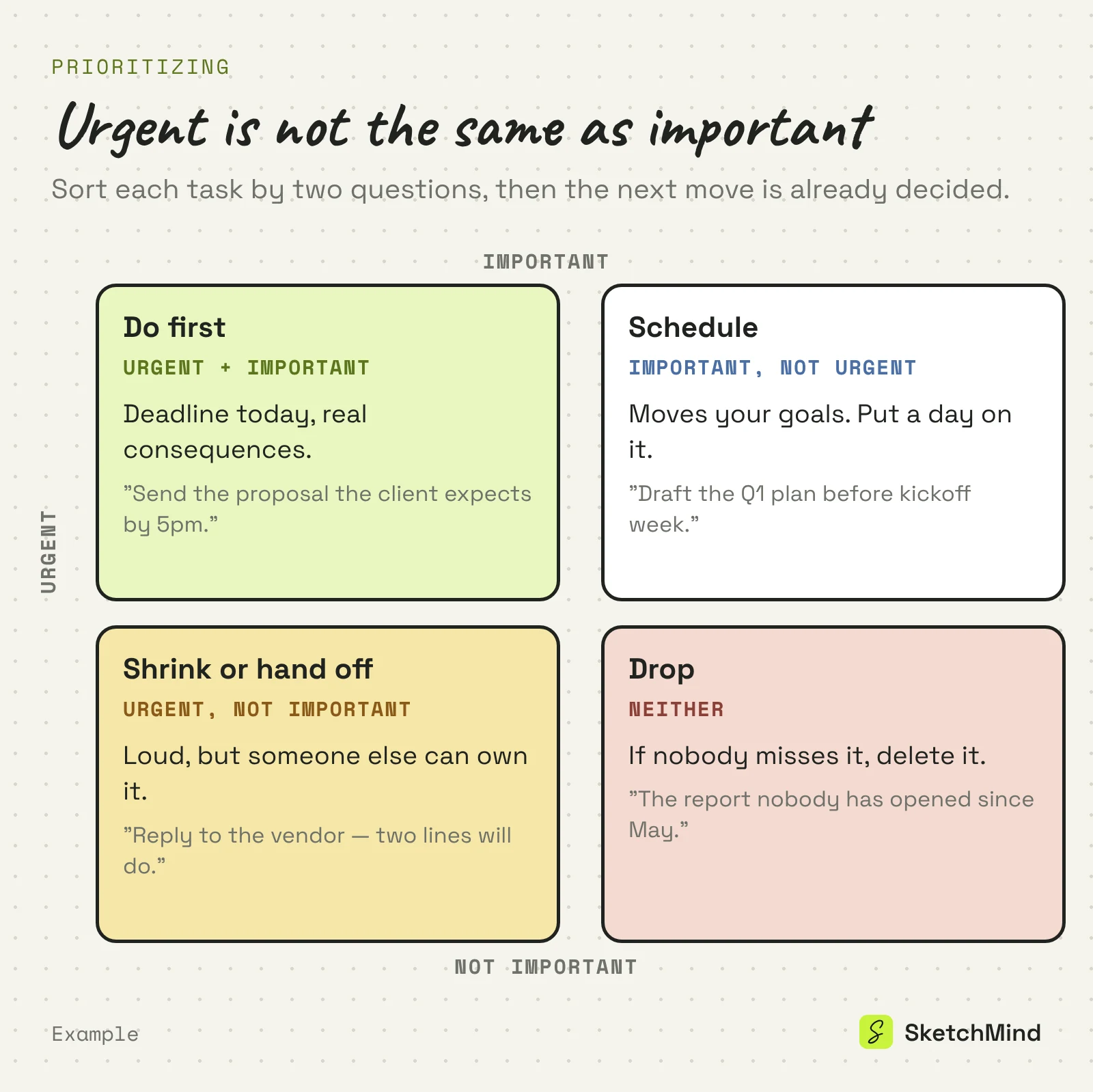
Urgent means the task has a clock on it. Important means the task has consequences for your goals. The two feel identical in the moment, which is exactly why a two-question sort works: is this urgent, and is this important? That gives four piles, each with its own move.
The daily version takes about ten minutes in the morning and runs in five steps.
Use the lightest method that still forces a decision. The matrix is the general-purpose tool; the others earn their place in specific situations.
Common methods compared
|Method|Best for|Weak spot|
|---|---|---|
|Urgent-important matrix|A messy mixed list|Needs honesty about "important"|
|Top three (1-3-5)|Daily planning|Ignores long-term work if used alone|
|MoSCoW (must/should/could/won't)|Scoping a project or sprint|Too heavy for a Tuesday|
|Eat the frog|Procrastinated single tasks|Not a system, just a start|
Whatever you pick, the method only works if the output is a sequence. A color-coded list where everything is "high" is the old list with extra steps.
A priority list needs a place where the days are visible, otherwise "schedule it" means nothing. In SketchMind, an AI whiteboard, that place is the Agenda: you add tasks in plain language ("Friday 14:00 review deck"), each task sits on a day, and you can attach the task to a board or a goal so the context travels with it. "Plan my day" lines up today's open tasks into 25-minute focus blocks, overdue work first and timed tasks at their time, and the Focus timer runs through the app at 15, 25 or 45 minutes, or anything from 5 to 180. Reminders come in the app and by email, with a morning overview at 08:00. Agenda, Goals and Focus are included on every plan. If your top three comes out of a bigger piece of work, an action plan with owners and dates is usually the step before the daily sort.
Review beats willpower. Three habits do most of the work: re-sort every morning instead of trusting yesterday's order, cap the day at three real outcomes, and read the carry-overs once a week. The weekly read matters most, because a list where nothing ever gets dropped is a list nobody believes. If you keep a running list per project, a project checklist that lives next to the work stops the same tasks from being re-prioritized forever.
Last updated: October 12, 2026. Checked against the current SketchMind app.
Sort every task by urgency and importance, then pick at most three to finish today. The sort decides the order; the top three keeps the day realistic.
A four-quadrant sort, often called the Eisenhower matrix: urgent and important tasks get done first, important ones get scheduled, urgent-but-unimportant ones get shrunk or handed off, and the rest gets dropped.
Three real outcomes. More than that and the list stops being a decision and becomes a wish.
Re-sort every morning in about ten minutes, and review carry-overs once a week. Priorities shift faster than lists do.
Treat the postponing as information. The task needs a smaller first step, a different owner, or it belongs in the drop pile.